EICR Landlord Certificate in Wythenshawe: Cost, Process and Timing
What actually happens during an EICR, what it costs in Wythenshawe, and why so many landlords leave it too late. Written from doing these inspections week in, week out.
We're based in Wythenshawe, so EICRs here make up a big chunk of what we do week to week. A lot of it is landlord work, some of it homeowners who've just had a mortgage valuation come back with a note about the wiring. The properties vary more than people expect. Wythenshawe was built mainly through the 1930s as one of the largest council estate developments in Europe, so you've got a lot of semis and terraces from that era still on their original circuits, sat next to newer infill housing and more recent developments around Manchester Airport and the Life Sciences Centre.
That mix matters, because the age of the property is the single biggest factor in how an EICR goes. A 1930s semi that's never been rewired will almost always come back with at least a C2 code somewhere. A house that had a rewire in the last 15-20 years usually sails through with C3s at worst.
What we're actually checking
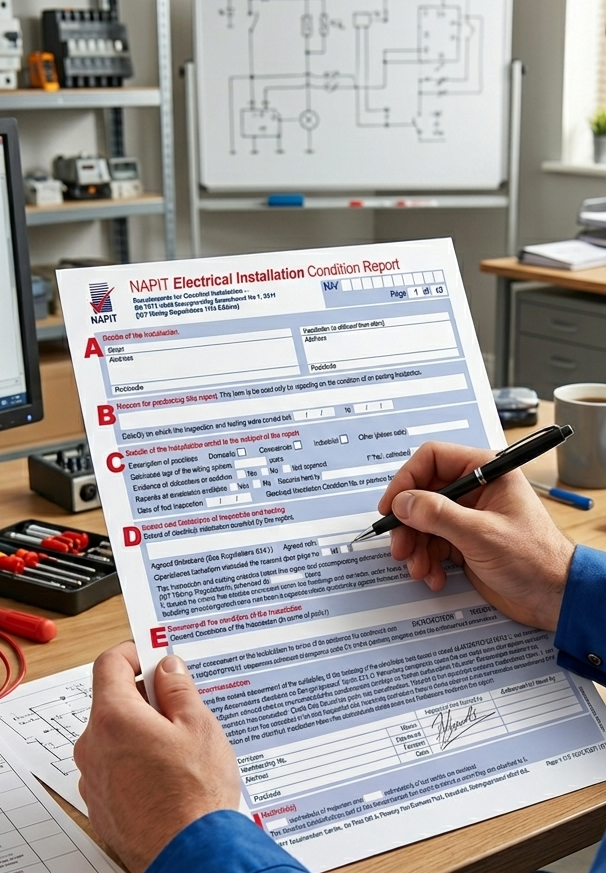
An EICR isn't a quick once-over with a torch. We're testing every circuit for earth continuity, insulation resistance and polarity, checking the consumer unit for RCD protection, and physically inspecting accessible wiring, sockets and switches for damage or degradation. On a standard 3-bed semi that's usually 2-4 hours on site.
At the end you get a report with codes. C1 means danger present, needs fixing immediately. C2 means potentially dangerous, needs fixing but the property is still safe to occupy in the meantime. C3 is just a recommendation for improvement, not a legal requirement to act on. Most of what we find on older Wythenshawe stock is C2, usually a lack of RCD protection on socket circuits, which older fuse boards just weren't built with.
What it costs and how long you've got
Our prices start from £150 for a small flat and £175 where a certificate for a rental property is needed. Property size and the number of circuits are what actually move that price, not the postcode.
For landlords, the legal position in England is straightforward: an EICR is required at least every 5 years, or at the start of a new tenancy, whichever comes first. If C1 or C2 issues come back, you've got 28 days to get them fixed and provide written confirmation to the tenant and, if requested, the local authority. Councils in Greater Manchester have been more active on enforcement over the past couple of years, so leaving it isn't really a viable strategy anymore.
Owner-occupiers aren't legally required to get one, but we'd still recommend it every 10 years, or immediately if you're buying a property with wiring you can't date. It's cheap reassurance compared to what a house fire or a botched insurance claim costs you.
If you get a C1 or C2
Don't panic, and don't assume it means a full rewire. Most C2s on Wythenshawe properties come down to consumer unit upgrades or bonding issues that take a day, not a fortnight. We quote for the remedial work on the spot when we're already there, so you're not waiting on a second visit and a second call-out charge.
Need an electrician in Wythenshawe?
NAPIT certified. Free quotes. 1-hour emergency response.